Profit matters, but cash flow matters most. Consistent cash flow allows businesses to stay agile, cover expenses, and pursue new opportunities. AmeriFactors provides funding solutions that help turn outstanding invoices into reliable cash flow.
"Entrepreneurs believe that profit is what matters most in a new enterprise. But profit is secondary. Cash flow matters most." Peter Drucker, Management Consultant, Educator, and Author.
Invoice Factoring vs. Merchant Cash Advance (MCA)
An Educational White Paper from AmeriFactors Financial Group. LLC
Executive Summary
Businesses need reliable access to working capital to make payroll, purchase inventory, pay vendors, accept new contracts, and support growth. However, the timing of customer payments does not always match the timing of business expenses. The best financing solution should do more than provide fast cash. It should support the long-term health, stability, and growth of the business.
When cash is needed quickly, many business owners consider a business cash advance, also known as a Merchant Cash Advance (MCA). These financing arrangements are often promoted as fast and easy to obtain, but the long-term effect on cash flow can be significant. Merchant Cash Advances may require daily or weekly withdrawals from a business bank account. They can also carry substantial costs and may create additional financial pressure when revenue slows or customers pay later than expected.
Invoice factoring provides a different approach. Rather than advancing money against future sales, invoice factoring allows a business to access working capital from eligible B2B invoices it has already earned. Funding is tied to outstanding accounts receivable, and the factor receives payment when the customer pays the invoice, not through withdrawals directly from the business account.
This white paper explains:
How Merchant Cash Advances work
How invoice factoring works
The key differences between an MCA and factoring
How each option affects cash flow
Common MCA risks and warning signs
Questions to ask before choosing business funding
Why invoice factoring may offer a more sustainable alternative for B2B companies
Why Businesses Need Working Capital
Even successful and growing companies can experience cash flow challenges. A business may complete its work, deliver its products, and issue invoices on time, yet still wait 30, 60, or even 90 days for customers to pay. During that waiting period, the company must continue covering its expenses.
Businesses commonly seek working capital for payroll, inventory, vendor payments, growth, seasonal needs, unexpected expenses, and slow-paying customers.
A cash flow shortage does not necessarily mean a business is struggling. In many cases, the company is growing faster than its available cash can support. The challenge is choosing a funding solution that addresses the immediate need without creating a larger financial problem.
What Is a Merchant Cash Advance and How Do They Work?
A Merchant Cash Advance is a form of revenue-based financing. The business receives a lump sum in exchange for the funder’s right to collect an agreed upon amount from future business sales or revenue. An MCA is generally structured differently from a conventional business loan. Instead of making one monthly payment, the business may be required to make daily or weekly payments through automatic withdrawals from its bank account. MCAs may appeal to companies that need money quickly or do not qualify for conventional financing. However, speed and convenience should be evaluated alongside the cost, payment structure, and effect on future cash flow.
A typical MCA transaction works as follows:
The business applies for funding.
The funder reviews revenue, bank statements, credit score, and sales activity, among other things.
The business receives a lump sum minus closing fee.
The funder establishes a total amount that must be remitted.
Payments are withdrawn daily or weekly.
Withdrawals continue until the agreed amount has been collected.
If the business misses a payment, the total amount will be recalculated to include significant additional fees and penalties.
Cash advances are not fully amortizing loans. Traditional loans reduce your principal balance over time through an amortization schedule that recalculates interest on the remaining principal. MCAs apply a flat multiplier called a “factor rate” to the entire advance in the beginning. The total principal plus the factor amount is owed from day one. Paying off the balance early typically does not reduce the overall cost or recalculate fees.
How Merchant Cash Advances Are Priced
As indicated above, Merchant Cash Advances commonly use a factor rate rather than a traditional interest rate. An MCA “factor rate” is not the same thing as the rate or fee associated with invoice factoring. Despite the similar words, they refer to two very different calculations and financing structures. A factor rate is a multiplier used to calculate the total amount the business is expected to remit. MCA providers commonly quote factor rates such as 1.20x, 1.35x, or 1.40x. For example, a 1.40x factor rate on a $100,000 advance results in a $140,000 total repayment amount, before any additional fees. (See the “Fee and Cashflow” section below for an example.)
Because the factor rate is applied to the original amount, it should not be confused with a conventional annual percentage rate. The repayment period may also be much shorter than a traditional loan, which can make the effective annual cost substantially higher than it first appears. Because MCA factor rates are not traditional interest rates, they may also make it difficult to understand the annualized cost of obtaining and repaying the funds over a relatively short period.
How MCA Payments Can Affect Cash Flow
Many businesses focus on how quickly they will receive the money but underestimate the effect of frequent withdrawals. With a traditional monthly payment, a business has more time to manage incoming and outgoing cash. With an MCA, money may be withdrawn every business day or every week before the company pays its other obligations. Even when the company generates enough revenue to make the payment, the timing can create financial pressure.
An MCA Does Not Eliminate the Underlying Cash Flow Gap
Many businesses accept an MCA because they need immediate cash. While an MCA can provide quick cash, it does not necessarily solve the underlying cash flow problem. Instead, it advances money based on future revenue not even yet earned, and begins collecting payments immediately. If the business is already waiting 30, 60, or 90 days for customers to pay, the MCA withdrawals may begin long before those customer payments arrive. As a result, the company may still face the original cash flow shortage while also managing a new daily or weekly obligation.
Warning Signs Before Accepting an MCA
A reputable provider should be willing to explain the transaction clearly and provide time for review. Business owners should pause and seek professional guidance when they encounter:
Pressure to sign immediately
Unclear cost disclosures
A focus on the daily payment instead of the total cost
Significant upfront fees
Unexplained broker fees
Fee and cost language without an example or detailed explanation
Confusing reconciliation procedures
Restrictions on additional financing or refinancing
Broad default language
Automatic judgments
Unclear personal guaranty requirements
Blank spaces or missing contract exhibits
Verbal promises that are not included in writing
Requests to misstate revenue or financial obligations
Financing intended to pay another MCA
Possible Risks of Merchant Cash Advances
Frequent Withdrawals
Daily or weekly payments can reduce financial flexibility and make it more difficult to cover essential expenses.
Short Repayment Period
The obligation may be collected over a relatively short period, placing intense pressure on operating cash.
High Total Cost
Factor rates and additional fees may make the total cost of the advance significantly higher than expected. If the MCA company does not give you a sample transaction and fee calculation, you should ask for one.
MCA Stacking
When one MCA reduces available cash, a business may take another advance to cover payroll or other expenses. This practice, often called MCA stacking, can result in multiple providers withdrawing money from the same operating account resulting in a much more significant cashflow issue.
Contractual Restrictions
MCA agreements may contain provisions related to UCC Filings, bank account access, remedies upon a default including an automatic judgment against the business, and required changes to business operations. Business owners should review these terms carefully.
Reduced Access to Future Financing
Existing MCA obligations, frequent withdrawals, or competing liens may make it more difficult to obtain other financing. Multiple MCA obligations can materially reduce a business’s refinancing options and make a successful restructuring or consolidation more difficult.
Aggressive Collection Activity
Some agreements provide significant collection rights if the business defaults or blocks withdrawals. Business owners should review the complete contract and seek qualified professional guidance before signing.
When is a Merchant Cash Advance a Poor Choice?
Cash flow is already strained
Customers regularly pay on extended terms
Revenue changes significantly from month to month or season to season
The business may need multiple advances
The funds are being used to pay another MCA
The company does not understand the total cost
Daily withdrawals may interfere with payroll or vendors
The business has substantial B2B invoices that could support another solution
The Most Important Question
The most important question is not: Can my business get approved? It is: Will this financing improve the company’s financial position after the funds are received?
What Is Invoice Factoring and How Does it Work?
Invoice factoring is a financial solution that converts eligible unpaid B2B invoices into immediate working capital. Rather than waiting for commercial customers to pay on 30, 60, or 90-day terms, a business can receive an advance against approved invoices.
A typical factoring process works as follows:
The business provides products or services to a commercial customer.
The business issues an invoice.
The invoice is submitted to the factoring company.
The factor verifies and approves the invoice.
The factor provides an advance.
The business’ customer pays the invoice according to its normal terms.
The remaining reserve, less the factoring fee, is released to the business according to the agreement.
Significantly, funding decisions are based on the creditworthiness of the business’s customers and the quality of the invoices not on the underlying financial condition of the business. This can make factoring available to some companies that may not qualify for conventional or MCA financing because of limited operating history, rapid growth, losses or even bankruptcy.
Invoice Factoring vs. Merchant Cash Advances
Although both solutions may provide fast working capital, they operate very differently.
Comparison
Merchant Cash Advance
Invoice Factoring
Source of Funding
Funding is based on anticipated future sales or revenue, which can change or fluctuate.
Funding is based on eligible invoices for products or services the business has already delivered.
Payment Structure
Payments will be withdrawn daily or weekly from the business bank account.
The factor receives payment when the business’ customer pays the factored invoice, not usually from the business itself.
Underwriting Focus
Focuses on financial information of the business such as revenue, bank deposits, and sales activity.
Focuses on the creditworthiness of the business’s commercial customers and the validity of the invoices.
Effect on Cash Flow
Frequent withdrawals reduce the cash available for operations or emergencies.
Funding accelerates cash already tied up in accounts receivable and does not typically represent a repayment obligation of the business.
Ability to Support Growth
The business may need to apply for another advance when additional cash is needed.
Funding is tied to actual sales; available funding may increase as the company generates more eligible invoices (and has increased associated expenses).
Best-Suited Businesses
May serve businesses with consistent sales and history and that understand the withdrawal and fee structure.
Serves any B2B company that sells products or services to other businesses or government entities on payment terms.
Fee and Cash Flow Comparison
The primary differences between MCAs and factoring are (1) the fees structure and (2) how each solution interacts with cash flow.
Merchant Cash Advance
As previously indicated, an MCA commonly uses a factor rate to determine the total remittance amount. An MCA factor rate is not the same as the fee or rate used in invoice factoring. It is also not a conventional annual percentage rate. For example, assume a company receives a $100,000 MCA with a factor rate of 1.40x.
$100,000 (advanced) × 1.40 = $140,000.
The business receives $100,000 and is responsible for remitting $140,000, before considering any additional fees. The $40,000 difference represents the cost associated with the advance.
The $140,000 will be repaid by the business directly through automatic bank withdrawals either daily or weekly.
Depending on the agreement, additional costs may include return payment fees, administrative fees, default charges, legal costs, or other contractual amounts. A default or other breach may also trigger acceleration or other remedies that materially increase the amount claimed to be due. Business owners should understand these provisions before signing and should not assume they will be able to continue making the original scheduled payments after a default.
Factoring
Factoring costs usually depend on how long the invoice is outstanding. They are expressed as a percentage of the face value of the invoice. The minimum fee is usually 1-2% of the face amount of the invoice. For example, if a business sells a $100,000 invoice, the factor may give the business $80,000 up front. Then, when the factor collects, it will give the business the remaining $20,000 less the factor’s fee. With a minimum fee of 2%, the business would get back and additional $18,000 for a total of $98,000 on a $100,000 invoice (plus administrative fees, such as wire fees).
In this example, the business receives $98,000 (total). The $2,000 difference represents the cost associated with the advance. Like a factor rate, a factor fee should not be confused with a conventional annual percentage rate.
The $100,000 will be repaid by the businesses’ customer directly so long as there is no dispute concerning the underlying goods or services provided. As an added benefit, many factors provide help with back-office functions such as delivery of invoices and assistance with collections.
Risk Comparison
No financing product is without obligations. The important question is whether the structure aligns with the business’s revenue cycle and long-term needs.
Merchant Cash Advance Considerations
Ability to service frequent and consistent withdrawals
High total cost
Whether additional advances will be necessary to repay the initial advance
Limited refinancing options
Aggressive default provisions
Pressure on operating cash
Invoice Factoring Considerations
Customer eligibility
Invoice verification process
Assistance with back-office functions such as invoicing and collections
Funding limits
Recourse or non-recourse structure
Recourse vs. Non-Recourse Factoring
Factoring agreements may be structured as recourse or non-recourse.
Recourse Factoring
With recourse factoring, the client may be required to repurchase or replace an invoice if the customer fails to pay, depending on the agreement.
Non-Recourse Factoring
With non-recourse factoring, the factor assumes certain defined customer credit risks for approved invoices, subject to the terms, exclusions, and conditions of the agreement. The non-recourse structure helps the business mitigate the risk that its customers cannot pay for financial reasons. This is particularly helpful where a business has only one large customer.
AmeriFactors specializes in non-recourse invoice factoring designed to help qualified B2B companies improve cash flow while reducing defined customer insolvency risks.
Frequently Asked Questions
Is a Merchant Cash Advance a Loan?
An MCA is commonly structured as the purchase of a portion of future sales or revenue rather than as a conventional loan. Legal and accounting treatment can vary depending on the agreement and applicable law or regulations.
Is Invoice Factoring a Loan?
From the factor’s perspective, an invoice purchase is generally viewed as an obligation of the business’ customer and not the business itself, particularly if the factoring agreement is non-recourse. However, there are exceptions, and legal and accounting treatment can vary depending on the agreement and applicable law or regulations.
Is Invoice Factoring Better Than an MCA?
Factoring is usually a better fit when a B2B company has eligible unpaid invoices and the primary problem is waiting for customers to pay.
Can a Business Use Factoring With Challenged Credit Including Bankruptcy?
Yes. Factoring decisions focus significantly on customer credit and invoice quality, although all applications remain subject to approval.
How AmeriFactors Helps Businesses Improve Cash Flow
AmeriFactors Financial Group has provided accounts receivable factoring solutions since 1990.
We help B2B companies turn approved invoices into working capital rather than waiting 30, 60, or 90 days for customer payments. Depending on approval, invoice verification, and funding conditions, AmeriFactors can provide funding in as little as four hours after an approved invoice is submitted.
AmeriFactors offers:
Non-recourse invoice factoring
Flexible funding based on eligible receivables
Support for startups and growing companies
Solutions for businesses with challenged credit or past bankruptcies
Customer credit monitoring
Accounts receivable management
Professional collections support
Personalized service
Funding across a wide range of industries
As a subsidiary of Gulf Coast Bank & Trust Company, AmeriFactors is also part of a broader financial organization with access to complementary business financing resources. Depending on a company’s qualifications, needs, and intended use of funds, other options may be available through affiliated companies, banking relationships, or trusted lending partners.
Conclusion: Choose Funding That Supports the Business
Merchant Cash Advances can provide fast access to money, but the speed of funding should be weighed against the total cost, fees payment frequency, contractual obligations, and effect on future cash flow and whether the chosen solution is a sustainable solution to the cashflow issue.
For B2B companies with money tied up in unpaid invoices, invoice factoring may provide a more sustainable path to working capital. Instead of advancing money against uncertain future sales, factoring allows the business to access cash from work it has already completed.
Explore Your Working Capital Options
Before accepting a Merchant Cash Advance, speak with AmeriFactors to determine whether your outstanding B2B invoices or another complementary financing solution may provide a better path forward. Call 800-884-3863 or visit amerifactors.com to request a free factoring quote.
Terms and conditions apply. Services offered by AmeriFactors® Financial Group, LLC
Important Notice: The information provided in this article is for general informational purposes only and should not be considered accounting, tax, legal, or financial advice. Businesses should consult with their CPA, attorney, or other qualified professional regarding their specific circumstances and the appropriate accounting, tax, legal, or financial treatment.
Commercial Loan Brokers: Your Competitive Advantage for Faster Funding
In the commercial finance world, speed matters.
Every day, commercial loan brokers lose deals because traditional lenders move too slowly, require too much documentation, or simply don't understand unique business situations. While banks and conventional lenders can be excellent options for some borrowers, many business owners need funding now, not weeks from now.
That's why successful commercial loan brokers know exactly who to call when a deal needs to move fast.
AmeriFactors is the funding partner brokers call when timing is critical, the borrower doesn't fit traditional lending guidelines, and commission opportunities are on the line.
Why Commercial Loan Brokers Lose Deals
The average business owner seeking financing is often facing a time-sensitive situation:
Payroll is due
Growth opportunities can't wait
Large customer orders need fulfillment
Cash flow is tight despite strong receivables
A traditional lender has already declined the request
When brokers send these deals through conventional lending channels, they often encounter:
Lengthy underwriting timelines
Strict credit requirements
Heavy collateral demands
Industry restrictions
Multiple rounds of document requests
The result? The borrower gets frustrated, looks elsewhere, or abandons the funding process altogether.
The AmeriFactors Difference: Built to Get to Yes
At AmeriFactors, we understand that every day a deal sits idle is a day your client isn't funded and you aren't earning a commission.
That's why our team is built around one simple principle: Get to yes quickly whenever possible.
Unlike traditional lenders, we focus on the strength of a company's receivables and business operations rather than relying solely on conventional lending metrics.
This allows us to help businesses that may not fit inside a bank's lending box.
Financing Solutions for Commercial Loan Brokers
Invoice Factoring
Businesses with outstanding invoices can turn their accounts receivable into immediate working capital instead of waiting 30, 60, or 90 days for payment.
Accounts Receivable Financing
Flexible funding solutions that help businesses maintain cash flow while continuing to grow.
Growth Capital
Funding that supports expansion opportunities, hiring initiatives, inventory purchases, and contract fulfillment.
Alternative Financing Solutions
When traditional financing isn't the right fit, AmeriFactors can often provide options that keep deals moving forward.
Why Brokers Choose AmeriFactors
Fast Decisions
We know your reputation depends on delivering solutions quickly. Our team works to evaluate opportunities efficiently so your clients get answers faster.
Transparent Communication
Brokers shouldn't have to chase updates.
We keep referral partners informed throughout the process, providing visibility from submission through funding.
Flexible Underwriting
Every business has a story. We take the time to understand the opportunity rather than relying on a rigid checklist.
Dedicated Partnership
Our broker relationships are built for the long term. When you bring a deal to AmeriFactors, you're working with a team committed to helping both you and your client succeed.
When Should Commercial Loan Brokers Contact AmeriFactors?
Urgent funding needs
Strong receivables
Rapid growth creating cash flow gaps
Recent bank decline
Unique industry circumstances
Borrowers who need flexibility
Time-sensitive opportunities
Close More Deals and Earn More Commissions
Commercial loan brokers succeed by finding solutions. When traditional lending channels slow down a deal, AmeriFactors can provide flexible financing options that help clients access working capital faster. Making AmeriFactors your first call can help you close more deals, strengthen client relationships, and increase commission opportunities.
Terms and conditions apply. Services offered by AmeriFactors® Financial Group, LLC, a wholly owned subsidiary of Gulf Coast Bank & Trust Co.
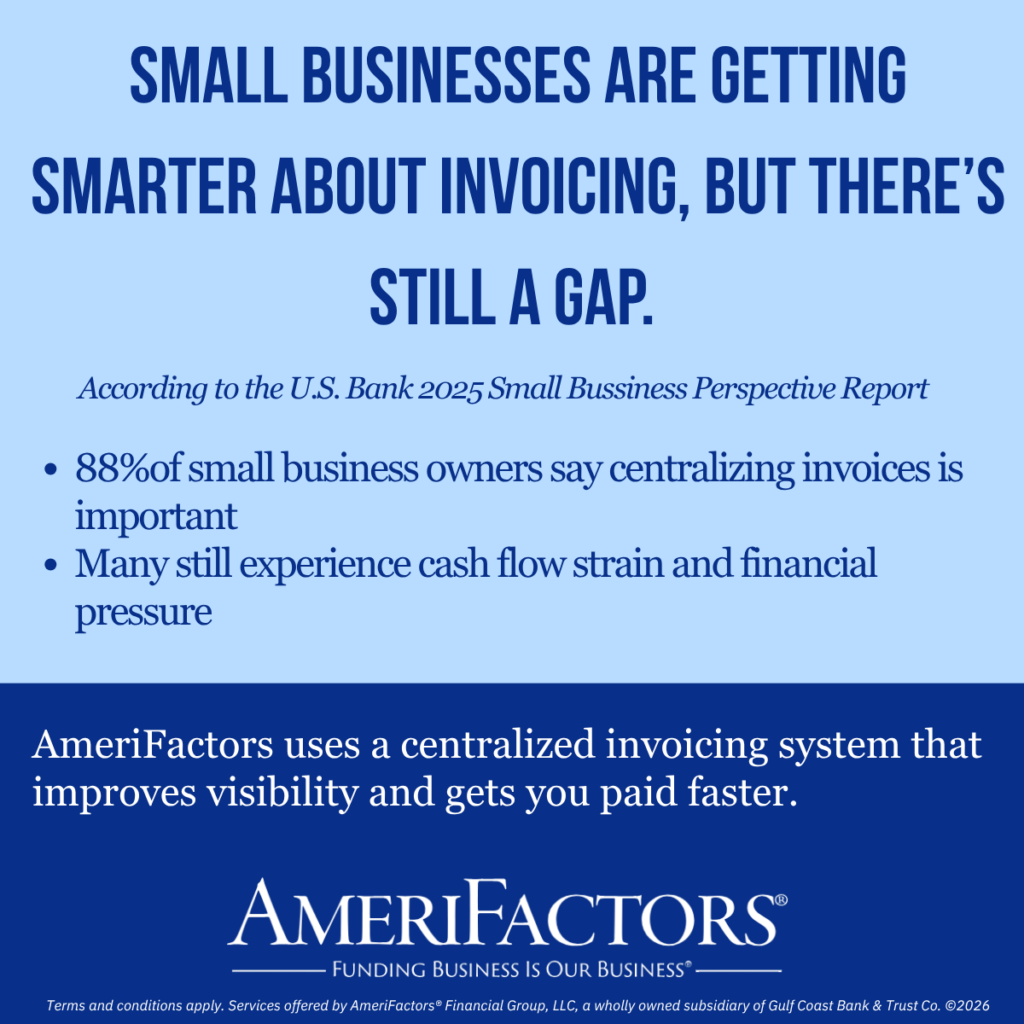
Small Businesses Are Getting Smarter About Invoicing
Getting smarter about invoicing is important. Getting paid faster is even better. Many small businesses have improved visibility into their receivables, but delayed customer payments can still create cash flow pressure. A centralized invoicing system helps you see what’s owed. Invoice factoring can help you put that money to work before payment arrives.
SMALL BUSINESSES ARE GETTING SMARTER ABOUT INVOICING, BUT THERE'S STILL A GAP. According to the U.S. Bank 2025 Small Business Perspective Report. 88% of small business owners say centralizing invoices is important. Many still experience cash flow strain and financial pressure. AmeriFactors uses a centralized invoicing system that improves visibility and gets you paid faster.
Don’t Let Late Payments Turn Up the Heat
Summer temperatures aren’t the only thing rising this time of year. Late customer payments can create cash flow pressure. AmeriFactors helps businesses access working capital tied up in outstanding invoices, providing funds while customers pay on their terms. Don’t let payment delays turn up the heat on your business this summer.
Don't let late payments turn up the heat!
$4.5M in Funding for a Commercial Painting Company in Texas
AmeriFactors recently funded $4,500,000 for a commercial painting company located in Texas. We help businesses access reliable funding solutions that support daily operations, payroll, and long-term growth opportunities. Contact us today to learn how AmeriFactors can support your business growth.
AmeriFactors is pleased to announce recent funding for a new client: $4,500,000 for a commercial painting company in Texas that has been in business for 32 years.
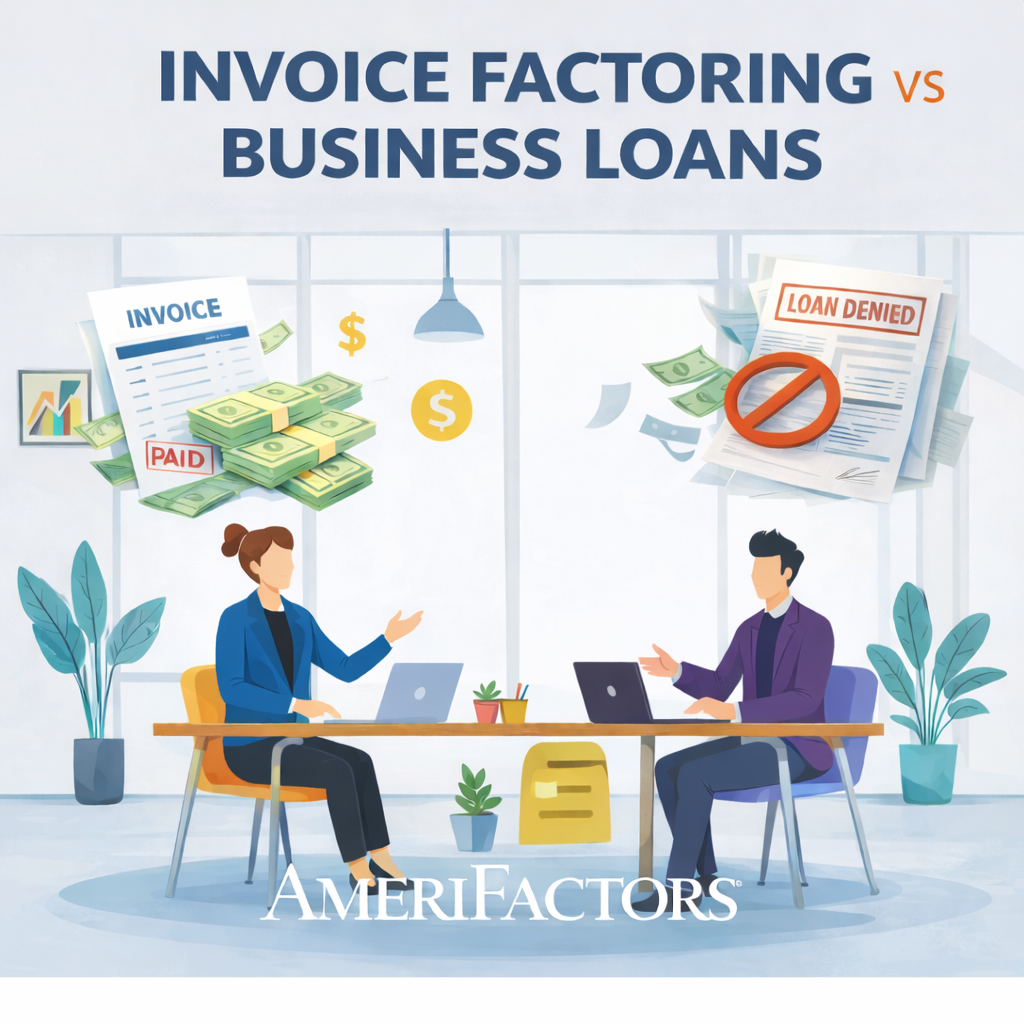
Invoice Factoring vs Business Loans: A Smart Alternative for Business Funding
Invoice factoring is a non-debt alternative to traditional business loans that helps businesses unlock working capital from unpaid invoices. This page explains the differences between invoice factoring and business loans, including approval, repayment, funding speed, and why businesses with credit challenges may consider factoring with AmeriFactors.
Invoice Factoring vs Business Loans - AmeriFactors
FAQs on AmeriFactors Factoring as a Smart Business Loan Alternative
When searching for a business loan, most companies are looking for one thing: reliable access to working capital. However, for many businesses, especially those with credit challenges, past financial setbacks, or limited operating history, traditional loans aren’t always accessible. That’s where invoice factoring with AmeriFactors offers a practical alternative. Instead of relying solely on your business credit, factoring provides a way to improve cash flow based on the strength of your receivables.
What Is Invoice Factoring?
Invoice factoring is a funding solution where a business sells its unpaid invoices to a factoring company, like AmeriFactors, in exchange for immediate cash. Instead of borrowing money, you’re accessing funds that are already owed to you. This makes factoring a non-debt alternative to traditional financing and a valuable option for businesses that may not qualify for conventional loans. With AmeriFactors, the focus is on the quality of your customers, not just your financial history.
What Is a Business Loan?
A business loan provides a lump sum of capital that must be repaid over time with interest. Approval is based on items like credit score, time in business, and financial performance. For businesses with lower credit scores, prior bankruptcies, or inconsistent financial history, qualifying for a loan can be difficult and in some cases, not possible.
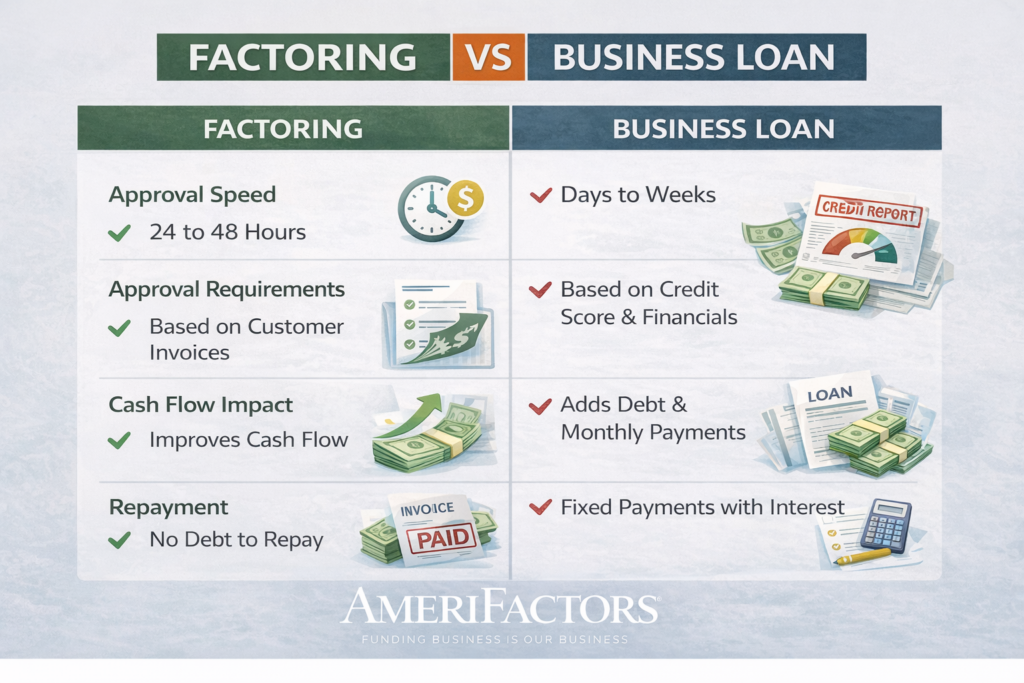
What are some key differences in Invoice Factoring vs Business Loans?
Feature
Invoice Factoring
Business Loan
Structure
Sale of invoices
Borrowed funds
Debt
No
Yes
Approval Based On
Customer credit
Business credit & history
Funding Speed
Fast (24–72 hours)
Slower (weeks or more)
Repayment
None
Monthly payments
Can You Get Funding with Bad Credit or After Bankruptcy?
Yes, depending on the financing method you choose. Traditional business loans are heavily dependent on your credit profile, which can make approval difficult if you have experienced low credit scores, past bankruptcies, financial setbacks, limited credit history, etc. Invoice factoring offers a different path. Because AmeriFactors evaluates the creditworthiness of your customers, not just your business, companies with credit challenges can still qualify for funding. This makes factoring a practical option for businesses that are: working to improve their credit, rebuilding after bankruptcy or being unable to meet strict bank lending requirements. Instead of being limited by past financial issues, factoring allows you to leverage your current sales and receivables to access working capital.
Why Businesses Consider Factoring as an Alternative?
Invoice factoring isn’t a replacement for every situation, but it is a strong alternative when traditional loans don’t align with your needs.
Improves Cash Flow Without Borrowing
Accessible Even with Credit Challenges
Unlike traditional lenders, AmeriFactors looks primarily at your customers’ creditworthiness—not just your own. This makes it possible for businesses with imperfect credit to still access funding.
Faster Access to Funds
For businesses that need capital quickly, AmeriFactors can provide funding in as little as 24 hours, compared to the longer timelines associated with bank loans.
Flexible and Scalable
Funding grows alongside your sales, making it a practical option for businesses experiencing growth or rebuilding after financial challenges.
Is invoice factoring better than a business loan?
Invoice factoring isn’t necessarily better, it’s a different type of solution. It can be a better fit for businesses that need fast cash flow, have credit challenges, or want to avoid taking on debt, while loans may be more suitable for long-term financing.
Does AmeriFactors invoice factoring show up as debt?
No. Invoice factoring is not a loan and does not appear as debt on your balance sheet or credit report.
Can startups or businesses with bad credit use AmeriFactors?
Yes. One of the key advantages of working with AmeriFactors is that approval is based largely on your customers’ ability to pay. This makes factoring a viable option for startups, businesses with bad credit, companies recovering from bankruptcy, or businesses that may not qualify for traditional financing.
Are there monthly payments with invoice factoring?
No. Factoring does not involve monthly payments or interest charges.
Why do businesses choose AmeriFactors over bank loans?
Businesses often choose factoring as an alternative because it is faster to access, more flexible, easier to qualify for, not dependent on strong credit, and not debt-based.
When to Consider Invoice Factoring?
Invoice factoring may be a good fit if your business:
Has outstanding invoices with delayed payment terms
Needs consistent cash flow for operations and/or growth
Has been turned down for a traditional loan
Is rebuilding after credit issues and/or bankruptcy
Wants funding that scales with revenue
With AmeriFactors, businesses can access working capital quickly even when traditional financing isn’t an option.
Final Thoughts
When exploring funding options, it’s important to look beyond just traditional loans especially if your business has faced financial challenges. As an alternative to business loans, AmeriFactors provides a practical way to improve cash flow, access capital, and move forward without being limited by past credit issues.
Explore Invoice Factoring with AmeriFactors
If you’ve been searching for a business loan but are facing challenges with approval or simply want a more flexible option, AmeriFactors can help.
What are some key difference in Invoice Factoring vs Business Loans?
Explore Invoice Factoring with AmeriFactors
If you’ve been searching for a business loan but are facing challenges with approval or simply want a more flexible option, AmeriFactors can help.
Contact AmeriFactors today to see how much working capital you can unlock and get the funding your business needs without relying on traditional lending requirements.
Terms and conditions apply. Services offered by AmeriFactors® Financial Group, LLC